Monday, March 20, 2017

Breaking bread


While the majority of BDSM play is done in dungeons (public or private), there’s another part of the community that’s no less important…munches. Munches are semi-official social gatherings for members of the kink community, which allow them to meet, chat and build relationships in an environment that’s dedicated to this sort of thing.

The primary advantage of munches is that they are very available. Munches are usually available in many cities…even ones that are too small to have a public dungeon. For example, if you live in Redmond, WA (like me), you can meet your fellow kinksters at one of 2 munches that happen every month, without having to travel to Seattle. Also, munches are usually at a restaurant, or someone’s home, so there are lesser costs associated with participation. Some munches are even targeted specifically at Parents, and so they can bring their kids and not worry about getting a babysitter.

Munches are usually organized by individuals from the community, and are usually advertised as ‘events’ on FetLife. It’s also not unusual to find a munch listing on a more public channel like FaceBook. A typical munch attracts 10-30 people, and some of them lead to some kind of ‘after-party’ at a nearby dungeon.

Are munches good? You bet’cha! Munches are a great way to meet new people, and make friends (maybe even ending up with new play-partners or even romantic partners). However, there’s one aspect of munches that need to be kept in mind. While munch attendees typically wear regular clothing, making the event look just like a friendly-meeting, the munches are regular, and are therefore sometimes “known” to people who live in the area. This means that you might run into someone you know, and if they are informed, they might realize you are a member of the kink community. Ultimately, it’s not a major risk, and most people think the benefits outweigh this risk.

Interested? Visit your FetLife, and search for “munch”. I’m sure you’ll find one to your liking.


See you at dinner!

Monday, March 13, 2017

Are Sadists evil?

We already discussed the topic of whether people who take lashings or beatings as part of BDSM are crazy…but what about those people who inflict those beatings onto them? Are those people evil? Why do they seem to enjoy hurting others?

Well, the answer to that lies in the fact that most BDSM “Sadists” aren’t actually sadistic. Sure enough, they inflict pain in what may look to the outside as cruelty, but in reality, the vast majority of them are not simply deriving pleasure due to someone else’s suffering.

In a BDSM role-play, the relationship between top and bottom are known as “power exchange”, because the power, or control, is exchanged between the top and bottom. The top may have partial or full control over the bottom, but he or she doesn’t take power…it is given to them willingly by the bottom, and this is done with full trust that the top will use that power well. In that kind of situation, the bottom receives pain willingly, and derives a great deal of enjoyment from it, and the top doesn’t enjoy the bottom’s suffering, but enjoys the bottom’s enjoyment, just like in a massage, the person receiving the massage enjoys it, and the masseuse might relish that joy. A good BDSM top excels not in his or her use of more power, but smart use of that power. Inflicting blows or lashes isn’t done in order to cause endless pain or damage, but to lead the bottom on the path for maximum enjoyment, without surpassing the bottom’s pain threshold. In that sense, BDSM tops actually share a very close and loving relationship with their bottoms, and if you closely observe a BDSM scene, you will notice that a top doesn’t blindly slap the bottom around like you would be chopping a tree, but rather observe him or her intently to make sure that the appropriate amount and quality of pain is delivered and absorbed properly.

In other words, a BDSM Sadist is no more evil than a teacher giving homework to his or her students. They are simply doing their best to take good care of their partners and do right by them. This is also why it’s so important to have a safe word as part of BDSM play, so that the bottom has a clear way to signal to the top if there is genuine distress. While admittedly, not all BDSM role-playing sessions are perfectly balanced and efficient, the vast majority of them involve a good connection between the top and the bottom, that it’s not common for the safe word to be used. Instead, the top is able to sense exactly when is it that he or she should continue, and when he or she should stop, as the bottom has reached full satisfaction from the scene.


See you on the rack!

Monday, March 6, 2017

No tomorrow

With an average viewership of only 750,000 per episode, No Tomorrow is yet another comedy that didn’t survive the commercial TV race of 2016. While as of now, the series hasn’t officially been cancelled, it didn’t receive a renewal decision either, so this, plus the almost-constantly declining ratings pretty much guarantee it’s not coming back.

Why am I dealing with a TV show on a sex-positive blog? Well, one thing that I found particularly alluring about this show is the character of Kareeme, played by actress Sarayu Blue. Blue plays a grumpy and cynical customer service rep on the show, but the fun part is how the character seems to be a proud sex-positive BDSM practitioner, who blurts out multiple reference to our culture in every episode.

For example, in Episode 6 of the show, Kareema’s brother says he doesn’t like strangers touching him, to which she responds with “where is it is the foundation of my social life”. Later, she says to another character “I’ve been into plenty of people, sometimes 2 or 3 at a time”, suggesting she’s polyamorous.

A few episodes later, in the Dec 6 episode (#9), she says to another character “wake me up when you do something that requires a safe word”. In addition to this, both herself, and Marta Milans, who plays her lover Sofia, wear sub collars in most of their scenes.


Considering the fact that the show happens (but not filmed) in Seattle, and Kareema’s specific reference to the “foundation” (possibly referring to the Foundation for Sex-Positive Culture), I have some suspicion that one of the show’s writers may have been involved with our sex positive community. If so, that would be fun to learn!

Monday, February 27, 2017

Making friends in the BDSM and Sex-positive community

The Sex-positive and BDSM communities have some of the friendliest, most open-minded people in the world, and making friends and contacts in such an atmosphere is super easy even for those of us who are more shy and timid. However, if you are not familiar with the rules and etiquette of these communities, it could still be a little intimating. On the other hand, If you plan on walking into a BDSM or sex club thinking that you’ll be instantly stormed by hordes of horny men or women…that’s not the reality either.

While BDSM practitioners and sex-positive people are super open minded, and very sexually active, one must keep in mind that they are not just a bunch of out-of-control horny sluts. While most of us don’t follow arbitrary sexual conduct rules like the “3 date rule”, that doesn’t mean they’ll jump in the sack with anyone who wants them. Generally speaking, the same social “rules” that govern how we behave anywhere also apply within the BDSM and SP community. This means that people want to get to know others before they engage in sex or BDSM play, and they won’t go for it with people they don’t feel safe and good with.

If you are very new to the community and don’t know anyone just yet, you might find yourself at an event or party, standing somewhere with your drink, and not sure what to do or where to start. You might see people around you engaged in all sorts of conversation or play, and have no idea how to join. Well, I don’t have any magic tricks to make shyness disappear, but one thing I’ve found is helpful to many is to arrive at an event early…and by early, I mean as soon as the doors open. At that point, there would be only a handful of people at the place, and most likely they wouldn’t have much to do either. That’s a golden opportunity to strike up a conversation and start making friends. Go over, offer a handshake and introduce yourself by your name or nickname (BTW, if your name is something completely unpronounceable like Mahershalalhashbaz, Szymankowszczyzna or Streichholzschächtelchen…this would be an excellent time to pick something easier like Ben or Kim). Then, start a conversation on some “small talk” topic. This could be anything, though you could consider aiming for one of the following common topics in the community:
  •           How long have you been in the community/coming here?
  •           What are your favorite kinks?
  •           What kind of stuff have you done?
  •           What’s your favorite party? (as most clubs have different themed parties)


Also, if it feels appropriate, offer a compliment about the other person’s clothing or general appearance. If you’ve seen that person in a scene (today or in the past), complimenting the scene would go a long way as well.

Another thing that can jumpstart a relationship is offering a massage or a back rub. We are not talking about erotic massage here – just a harmless, non-threatening rub; and most people in the sex-positive community will gladly accept it. Make sure you use a soothing and friendly tone (as opposed to a creepy, stalky one) and express some concern (for example: “Hey…it looks like you could really use a back rub right now…” would be better than “I’d like to rub your back”).

If the other person accepts, this would be a good opportunity to engage in conversation, and the person will stick around for at least a few minutes while you give the massage. If you do a good job, not only will you have gained an acquaintance, but that person might also tell others about it, creating a reputation for you.

Once you’ve gotten acquainted with a few folk, the next step would be to try to join conversations that include people you already know. Be watchful and make sure you don’t butt-in on private conversations (the distance between the talkers would be a good indicator of that) and if you stand next to the talkers, chances are the person you know will introduce you to the other one.

Keep in mind that FetLife is the SP and BDSM communities’ social network, so be prepared to give people your FetLife alias (*), and you can even get yourself a business card with the name printed, to make it easier for people to remember, as I discussed in an earlier post.

* If your FetLife alias is one that’s hard to ‘get’ during normal conversation, that’s probably a good idea to try to find a new one that’s easier for others to hear and remember. For example “BleedingNipples” is going to be much more memorable than “Swagr1989”

With any luck, you’ll have 4-5 new friends pretty fast, and within a few weeks, you’ll have personally met and spoke to the majority of the regular members of the establishment. If you continue with massaging people regularly, pretty soon people will be chasing YOU to say hi!

See you on the massage table!


Thursday, February 23, 2017

Making a flogger

Floggers are probably the most used tools in BDSM, as well as a well-recognized symbol of our lifestyle. Being relatively easy to make, floggers are also some of the most diverse tools out there. While anyone can go online and grab one off eBay or Amazon for as low as $1.2 (that's a pretty low end one, obviously), having a heavy and high quality one is not only important, but also a primary source of pride for any BDSM top. These kinds of floggers can cost $100 or even more, but you can make one yourself for a fraction of the cost…and have something to show-off too.


Floggers are pretty simple, if you think about it. They are made from some stick, typically 8-9" long, and some fabric cut into strips 3/8-1/2" wide (tassels) and about 20" long. The only tricky part to a good flogger is making sure the tassels are properly attached to the handle, so that the thing doesn't break apart.

To make a flogger, start by locating the material. You can make a flogger from virtually any soft material, from strands of rope, through a cut-up pair of pants, and up to strips of thick and heavy leather. Different materials lead to different sensations, and affect the thuddy or stingy properties of the flogger, so it's important to choose well. Many people think a flogger HAS to be made of leather, but there's no law or rule that dictates that. No doubt that leather floggers look "professional", and using one made from a pair of jeans may feel amateurish and embarrassing, but in reality, leather floggers have a big disadvantage. Leather, even though it's nice and expensive, can be quite challenging to clean up, since leather can't be laundried, and it responds badly to water. The problem is that water washes away the oils that keep leather soft and flexible, so the cleaning process may make the leather much less resilient. In addition, the water may ruin the leather's smooth texture, and deform the tassels.

I'll discuss the topic of finding and buying leather in a later article, but for now, just keep in mind that there's nothing wrong with using fabric, pleather, rope or any other soft material to make your flogger, and it might lead to a flogger that's easier to use and maintain.


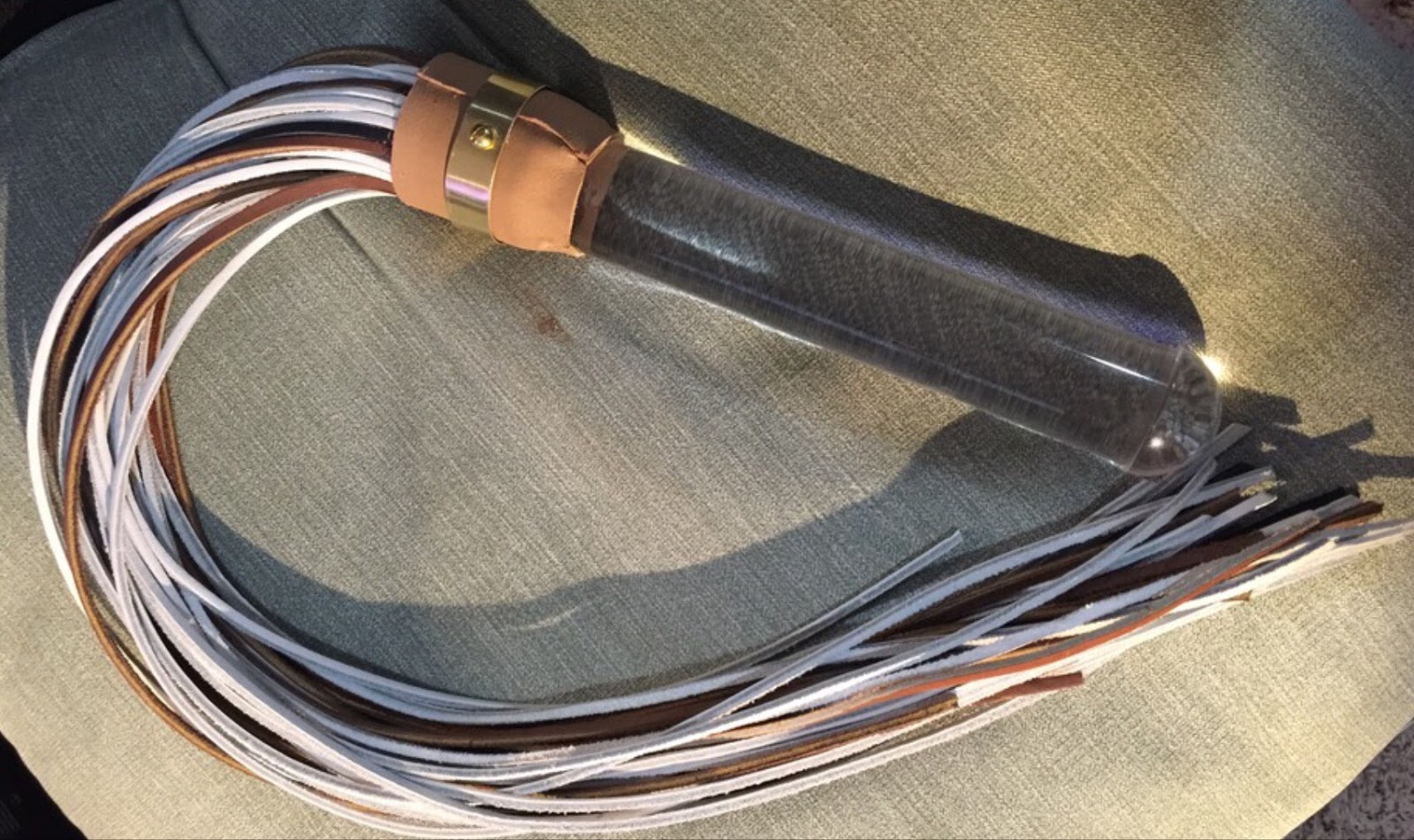
For a handle, the ideal material is wood, because it's the easiest to attach the tassels to. A 1 ½" or 1 ¼" thick wood stick would work great, and a $4 stick from Home Depot can be used to make 4-5 floggers. Some makers enjoy decorating the handle in various ways, from simple stain or paint, all the way through elaborate grooves, ornaments and leather coating. All this is up to you, of course, and there's a lot of fun to be had coming up with interesting designs. You can also purchase a piece of wood that's already decorated, such as a table or chair leg that comes with an interesting pattern (they typically sell for $5-10 at Home Depot and similar stores). Another alternative is an acrylic handle, which looks very nice, and can also be used as an insertable toy. Acrylic rods can be purchased at plastics supply shop, like the Tap Plastics chain, which has stores across the US. A 1 ¼" thick 9" acrylic rod would cost about $9. You can also try to think-up other creative handle solutions, such as a flogger I made using a Star-Wars Light Saber handle (the instructions for using it are "Use the force!").

To make the flogger, cut your chosen material to a square about 20" x 20", and then cut it to stripes that are between 3/8" to ½" wide. Don't cut it all the way through, though - leave the top 2" attached. It would be ideal to use a long ruler and a snap-knife to achieve nice and uniform tassels, but it can be also done with simple scissors and the flogger would be just as effective if the cut is not perfectly straight. If your material is already in smaller pieces (if you used leather scraps, or recycled an old leather coat), you might need to work a little extra when attaching the pieces to the handle.


Next, use some strong glue to attach the edge of the cloth to the handle. A contact glue such as E6000 is ideal, and you can also use Scotch High Performance Repair Glue (ADH669). I recommend gluing just the 1st inch and letting it dry. Once that has set, roll the cloth around the handle tightly, adding a bit of glue with every wind. Make sure not to put too much glue, as the tightening may cause it to ooze out and drip over the tassels. When you reach the end of your cloth, tie it around with a cable-tie or rope to prevent it from uncoiling, and let it set.


Once the glue has fully bonded, drill holes through the fabric into the handle, and secure it with screws. Depending on the thickness of the handle and the tassel material, you might consider using washers under the screw heads to avoid the flogger from breaking apart (remember…the material will be absorbing a lot of energy when you fling it!). In my floggers, I typically use two screws close to the end of the wrap, and one or two screws on the opposite side. With some of the lager floggers I made, I used 6 screws with 120 degrees in-between. Whatever you do, don't neglect drilling holes into the handle before putting in the screws, as you risk the wood splitting otherwise, which will force you to start almost from scratch. Also, place the screws around the handle with a bit of an offset, to avoid the screws hitting each other at the center of the handle and reducing the integrity of the wood.


Good luck with your floggers, and see you at the dungeon!

Monday, February 13, 2017

How did Fifty Shades get it wrong?

With over 60 million copies sold, the book series Fifty Shades of Grey by E.L. James has been one of the most successful books in history, and generated a huge amount of interest in BDSM. While we in the BDSM community owe a lot to the book for raising awareness to our lifestyle and getting many people into it, many of us feel a great deal of resentment towards the book as well. With the 2nd movie having been released this weekend (and making around $150 million dollars), this is a good time to see where Erika James went wrong.

The reason for the resentment is due to the fact that the book portraits BDSM in a way that is very far from how it really is. For example, a recurring theme in the book is the prospect of Christian Grey trying to get Ana to enter a legal contract with him for a dom/sub relationship, and pushing her into being a submissive against her will. While not being strictly forceful, Christian Grey is, in fact, a sexual predator, and uses unethical practices to try to force Ana into becoming his submissive. At the very least, the great inequality between the very attractive millionaire and a timid student makes the entire relationship sour from the beginning (the ‘might makes right’ syndrome). Would have Ana continued to see Christian if he hasn’t showered her with expensive gifts? Would she have consented freely to the sex or the BDSM scenes if he was just a regular guy like her? Probably not.

As we all know, in real life too, greatly-unequal relationship sometimes include or lead to some level of abuse by the strong/powerful/wealthy partner, but associating this with BDSM culture may make people think of it as something that’s normal or expected in any BDSM relationship. However, in reality, the exact opposite is true.  In a BDSM dom/sub relationship, even though the dom controls the sub, this control is GIVEN to the dom by the sub, out of the sub’s will or need to be dominated, not because they want to appease the dom or as ‘payment’ for sex or love. Similarly, in a role-play scene, the bottom asks the top to inflict pain on them because they want and enjoy it, not as some reluctant agreement aimed to gain the top’s affection or attention.

Another problem with the book is that the spike in interest also led to people attempting to experiment BDSM role play without any guidance or experience, which led not only to disappointment, but also to a significantly high number of injuries and accidents.

If you have read the book, and curious to try BDSM, but haven’t delved into it quite yet, I would encourage you to forget everything you read there. At most BDSM clubs, you won't find any handsome millionaires looking for love, and steaming sex scenes aren't that common either. Instead, read this blog, and come join a BDSM party in your area. You will find that most of us are warm and welcoming people, who will be happy to show you around and ease you into the culture without needing to compromise your values and safety. Many venues also organize "tasting" events, where you can experience various instruments, devices and techniques to see how it feels like!

See you at the dungeon!

Monday, February 6, 2017

What is Sex Positive?


The term “Sex-Positive” comes up a lot in the BDSM world, and even more specifically in the Seattle community, as our main club is specifically named “The Center for Sex-Positive Culture” (CSPC). This begs the question what IS sex-positive, and what’s the big deal?
Sex-positive is a concept which is the basis for a social movement by the same name. It goes back almost a century ago to the Austrian psychoanalyst Wilhelm Reich, who wrote about it first in his book The Invasion of Compulsory Sex-Morality (Part of which you can read here and the full thing can be ordered here).
The concept of sex-positive suggests that sex should be considered by all to be a good, healthy and normal thing. This position is in contrast to the common state of mind in many western societies (*), which views sex as shameful, sinful and even disgusting. One might argue that this isn’t the case, citing how common sex and nudity is in our culture, even in mainstream broadcast television, but even though we have made a lot of progress, the core values (at least in America) are still quite negative towards sex (for example...how many people you know that you could say "I masturbated to your photo last night, and came SO hard"?). It’s true that sexual content is more readily available, and less restricted than it was a decade or two ago, but most Americans still hold values that define sex as something that should not be discussed (let alone performed) in public. Even today, in 2017, it doesn’t take much more than a shot of a woman in a Bikini or a kissing scene to get a movie rated “PG-13”, and Women who breastfeed their infants in public still get routinely harassed.
* This isn’t to say that every person in Western Society feel this way…just that it’s the dominant view shared by most people
People who subscribe to the sex-positive view feel that sexual attraction between adults is nothing to be ashamed of, and acting on it shouldn't be more restricted or judged than engaging in a game of chess or sharing a meal. That doesn’t mean necessarily that people would or should jump into bed together without any considerations…just that they shouldn’t avoid that due to arbitrary rules. For example, many people follow the “3 date rule”, which dictates that people should not have sex before they completed at least 3 dates. Other, even more extreme rules say that a woman shouldn’t ask a man out, but rather wait for the man to initiate the romantic relationship (presumably because a woman initiating a relationship is promiscuous, and that being promiscuous is bad). These values and rules are often taught to people at an early age, by their parents, friends and the media (mostly romantic comedies) and continue to permeate our world very deeply.
Within the sex-positive community, people feel completely free to voice their appreciation or attraction to another (politely and respectfully!), and if the feelings are mutual, they usually feel free to engage in romantic or sexual activity at-will. They also engage in this activity outside of the classic confined spaces of the bedroom and anywhere where it is legal and doesn’t hurt or offend others. This doesn’t mean that a couple would go ahead with a loud intercourse session on the street or in front of their children, but on the other hand, they wouldn’t go to lengths to hide the fact that they are engaging in sex (for example, society’s sex-negative rules suggest that intercourse would only be OK after the kids have gone to sleep so that the kids don’t know of it).
Most of us in the sex-positive community don’t try too much to change the world, but most of us certainly hope a day will come where saying “mom and dad are going upstairs to have sex” to a child wouldn’t risk a raid by Social Services and when a woman walking around topless wouldn’t risk her being thrown in jail (New York, Hawaii, Maine, Ohio, and Texas are the only states in the US that explicitly allow a woman being topless in public).
Will this day ever come? It’s hard to say for sure. Even as late as 2004, female nudity on public television has drawn massive protests by viewers, and the Federal Communications Commission (FCC) still limits what can be shown on public television. Studies show that currently there’s twice as much sexual activity being depicted on television compared to previous decades, and the success of shows like Game of Thrones and Billions suggest that sex-positive values are becoming more common and acceptable to the American public. Perhaps when the current generation (Millennials, a.k.a. Generation Y) become the dominant in media and business, we will start to see a shift in public opinion. Me and my friends certainly hope so!