Monday, February 27, 2017

Making friends in the BDSM and Sex-positive community

The Sex-positive and BDSM communities have some of the friendliest, most open-minded people in the world, and making friends and contacts in such an atmosphere is super easy even for those of us who are more shy and timid. However, if you are not familiar with the rules and etiquette of these communities, it could still be a little intimating. On the other hand, If you plan on walking into a BDSM or sex club thinking that you’ll be instantly stormed by hordes of horny men or women…that’s not the reality either.

While BDSM practitioners and sex-positive people are super open minded, and very sexually active, one must keep in mind that they are not just a bunch of out-of-control horny sluts. While most of us don’t follow arbitrary sexual conduct rules like the “3 date rule”, that doesn’t mean they’ll jump in the sack with anyone who wants them. Generally speaking, the same social “rules” that govern how we behave anywhere also apply within the BDSM and SP community. This means that people want to get to know others before they engage in sex or BDSM play, and they won’t go for it with people they don’t feel safe and good with.

If you are very new to the community and don’t know anyone just yet, you might find yourself at an event or party, standing somewhere with your drink, and not sure what to do or where to start. You might see people around you engaged in all sorts of conversation or play, and have no idea how to join. Well, I don’t have any magic tricks to make shyness disappear, but one thing I’ve found is helpful to many is to arrive at an event early…and by early, I mean as soon as the doors open. At that point, there would be only a handful of people at the place, and most likely they wouldn’t have much to do either. That’s a golden opportunity to strike up a conversation and start making friends. Go over, offer a handshake and introduce yourself by your name or nickname (BTW, if your name is something completely unpronounceable like Mahershalalhashbaz, Szymankowszczyzna or Streichholzschächtelchen…this would be an excellent time to pick something easier like Ben or Kim). Then, start a conversation on some “small talk” topic. This could be anything, though you could consider aiming for one of the following common topics in the community:
  •           How long have you been in the community/coming here?
  •           What are your favorite kinks?
  •           What kind of stuff have you done?
  •           What’s your favorite party? (as most clubs have different themed parties)


Also, if it feels appropriate, offer a compliment about the other person’s clothing or general appearance. If you’ve seen that person in a scene (today or in the past), complimenting the scene would go a long way as well.

Another thing that can jumpstart a relationship is offering a massage or a back rub. We are not talking about erotic massage here – just a harmless, non-threatening rub; and most people in the sex-positive community will gladly accept it. Make sure you use a soothing and friendly tone (as opposed to a creepy, stalky one) and express some concern (for example: “Hey…it looks like you could really use a back rub right now…” would be better than “I’d like to rub your back”).

If the other person accepts, this would be a good opportunity to engage in conversation, and the person will stick around for at least a few minutes while you give the massage. If you do a good job, not only will you have gained an acquaintance, but that person might also tell others about it, creating a reputation for you.

Once you’ve gotten acquainted with a few folk, the next step would be to try to join conversations that include people you already know. Be watchful and make sure you don’t butt-in on private conversations (the distance between the talkers would be a good indicator of that) and if you stand next to the talkers, chances are the person you know will introduce you to the other one.

Keep in mind that FetLife is the SP and BDSM communities’ social network, so be prepared to give people your FetLife alias (*), and you can even get yourself a business card with the name printed, to make it easier for people to remember, as I discussed in an earlier post.

* If your FetLife alias is one that’s hard to ‘get’ during normal conversation, that’s probably a good idea to try to find a new one that’s easier for others to hear and remember. For example “BleedingNipples” is going to be much more memorable than “Swagr1989”

With any luck, you’ll have 4-5 new friends pretty fast, and within a few weeks, you’ll have personally met and spoke to the majority of the regular members of the establishment. If you continue with massaging people regularly, pretty soon people will be chasing YOU to say hi!

See you on the massage table!


Thursday, February 23, 2017

Making a flogger

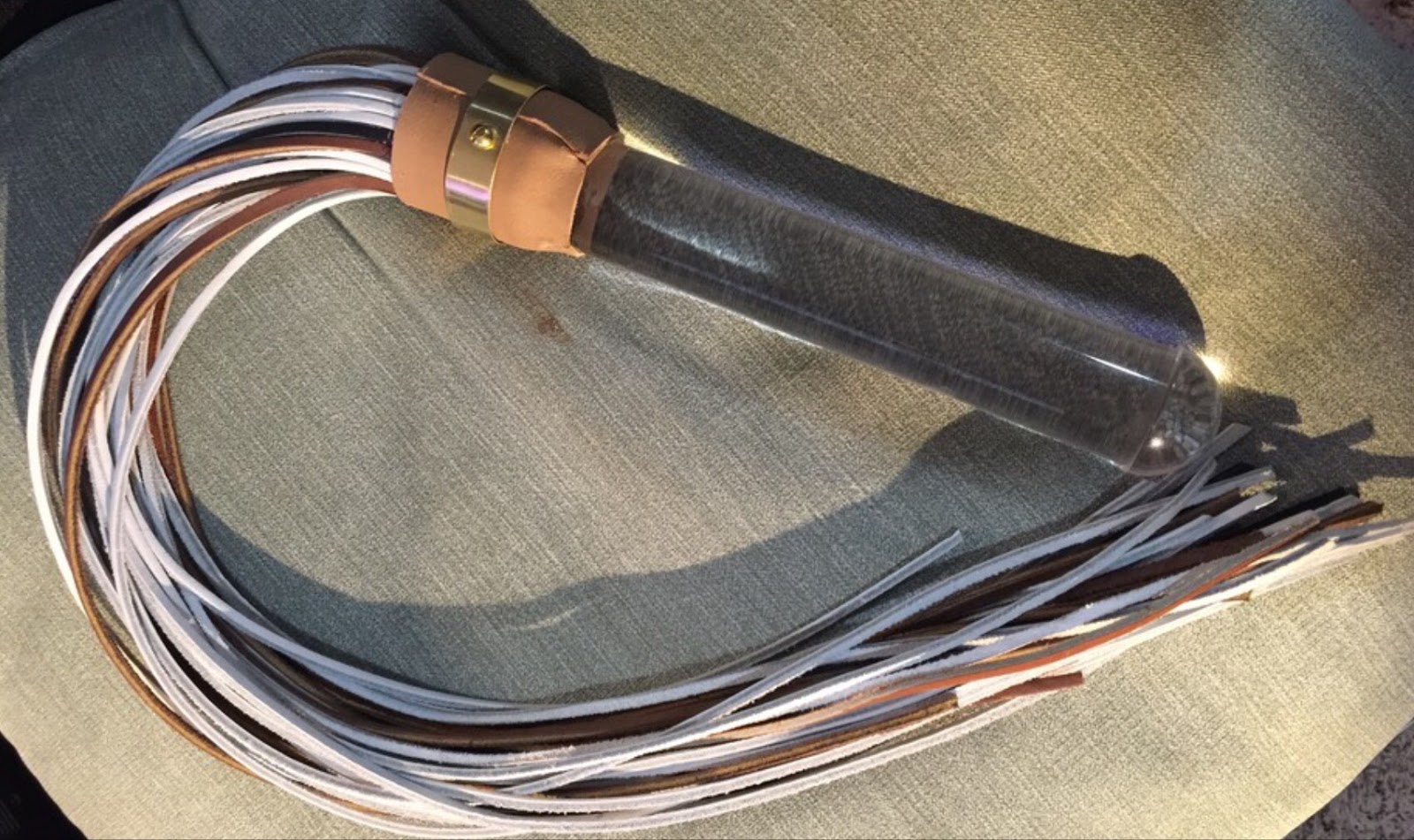
Floggers are probably the most used tools in BDSM, as well as a well-recognized symbol of our lifestyle. Being relatively easy to make, floggers are also some of the most diverse tools out there. While anyone can go online and grab one off eBay or Amazon for as low as $1.2 (that's a pretty low end one, obviously), having a heavy and high quality one is not only important, but also a primary source of pride for any BDSM top. These kinds of floggers can cost $100 or even more, but you can make one yourself for a fraction of the cost…and have something to show-off too.


Floggers are pretty simple, if you think about it. They are made from some stick, typically 8-9" long, and some fabric cut into strips 3/8-1/2" wide (tassels) and about 20" long. The only tricky part to a good flogger is making sure the tassels are properly attached to the handle, so that the thing doesn't break apart.

To make a flogger, start by locating the material. You can make a flogger from virtually any soft material, from strands of rope, through a cut-up pair of pants, and up to strips of thick and heavy leather. Different materials lead to different sensations, and affect the thuddy or stingy properties of the flogger, so it's important to choose well. Many people think a flogger HAS to be made of leather, but there's no law or rule that dictates that. No doubt that leather floggers look "professional", and using one made from a pair of jeans may feel amateurish and embarrassing, but in reality, leather floggers have a big disadvantage. Leather, even though it's nice and expensive, can be quite challenging to clean up, since leather can't be laundried, and it responds badly to water. The problem is that water washes away the oils that keep leather soft and flexible, so the cleaning process may make the leather much less resilient. In addition, the water may ruin the leather's smooth texture, and deform the tassels.

I'll discuss the topic of finding and buying leather in a later article, but for now, just keep in mind that there's nothing wrong with using fabric, pleather, rope or any other soft material to make your flogger, and it might lead to a flogger that's easier to use and maintain.


For a handle, the ideal material is wood, because it's the easiest to attach the tassels to. A 1 ½" or 1 ¼" thick wood stick would work great, and a $4 stick from Home Depot can be used to make 4-5 floggers. Some makers enjoy decorating the handle in various ways, from simple stain or paint, all the way through elaborate grooves, ornaments and leather coating. All this is up to you, of course, and there's a lot of fun to be had coming up with interesting designs. You can also purchase a piece of wood that's already decorated, such as a table or chair leg that comes with an interesting pattern (they typically sell for $5-10 at Home Depot and similar stores). Another alternative is an acrylic handle, which looks very nice, and can also be used as an insertable toy. Acrylic rods can be purchased at plastics supply shop, like the Tap Plastics chain, which has stores across the US. A 1 ¼" thick 9" acrylic rod would cost about $9. You can also try to think-up other creative handle solutions, such as a flogger I made using a Star-Wars Light Saber handle (the instructions for using it are "Use the force!").

To make the flogger, cut your chosen material to a square about 20" x 20", and then cut it to stripes that are between 3/8" to ½" wide. Don't cut it all the way through, though - leave the top 2" attached. It would be ideal to use a long ruler and a snap-knife to achieve nice and uniform tassels, but it can be also done with simple scissors and the flogger would be just as effective if the cut is not perfectly straight. If your material is already in smaller pieces (if you used leather scraps, or recycled an old leather coat), you might need to work a little extra when attaching the pieces to the handle.


Next, use some strong glue to attach the edge of the cloth to the handle. A contact glue such as E6000 is ideal, and you can also use Scotch High Performance Repair Glue (ADH669). I recommend gluing just the 1st inch and letting it dry. Once that has set, roll the cloth around the handle tightly, adding a bit of glue with every wind. Make sure not to put too much glue, as the tightening may cause it to ooze out and drip over the tassels. When you reach the end of your cloth, tie it around with a cable-tie or rope to prevent it from uncoiling, and let it set.


Once the glue has fully bonded, drill holes through the fabric into the handle, and secure it with screws. Depending on the thickness of the handle and the tassel material, you might consider using washers under the screw heads to avoid the flogger from breaking apart (remember…the material will be absorbing a lot of energy when you fling it!). In my floggers, I typically use two screws close to the end of the wrap, and one or two screws on the opposite side. With some of the lager floggers I made, I used 6 screws with 120 degrees in-between. Whatever you do, don't neglect drilling holes into the handle before putting in the screws, as you risk the wood splitting otherwise, which will force you to start almost from scratch. Also, place the screws around the handle with a bit of an offset, to avoid the screws hitting each other at the center of the handle and reducing the integrity of the wood.


Good luck with your floggers, and see you at the dungeon!

Monday, February 13, 2017

How did Fifty Shades get it wrong?

With over 60 million copies sold, the book series Fifty Shades of Grey by E.L. James has been one of the most successful books in history, and generated a huge amount of interest in BDSM. While we in the BDSM community owe a lot to the book for raising awareness to our lifestyle and getting many people into it, many of us feel a great deal of resentment towards the book as well. With the 2nd movie having been released this weekend (and making around $150 million dollars), this is a good time to see where Erika James went wrong.

The reason for the resentment is due to the fact that the book portraits BDSM in a way that is very far from how it really is. For example, a recurring theme in the book is the prospect of Christian Grey trying to get Ana to enter a legal contract with him for a dom/sub relationship, and pushing her into being a submissive against her will. While not being strictly forceful, Christian Grey is, in fact, a sexual predator, and uses unethical practices to try to force Ana into becoming his submissive. At the very least, the great inequality between the very attractive millionaire and a timid student makes the entire relationship sour from the beginning (the ‘might makes right’ syndrome). Would have Ana continued to see Christian if he hasn’t showered her with expensive gifts? Would she have consented freely to the sex or the BDSM scenes if he was just a regular guy like her? Probably not.

As we all know, in real life too, greatly-unequal relationship sometimes include or lead to some level of abuse by the strong/powerful/wealthy partner, but associating this with BDSM culture may make people think of it as something that’s normal or expected in any BDSM relationship. However, in reality, the exact opposite is true.  In a BDSM dom/sub relationship, even though the dom controls the sub, this control is GIVEN to the dom by the sub, out of the sub’s will or need to be dominated, not because they want to appease the dom or as ‘payment’ for sex or love. Similarly, in a role-play scene, the bottom asks the top to inflict pain on them because they want and enjoy it, not as some reluctant agreement aimed to gain the top’s affection or attention.

Another problem with the book is that the spike in interest also led to people attempting to experiment BDSM role play without any guidance or experience, which led not only to disappointment, but also to a significantly high number of injuries and accidents.

If you have read the book, and curious to try BDSM, but haven’t delved into it quite yet, I would encourage you to forget everything you read there. At most BDSM clubs, you won't find any handsome millionaires looking for love, and steaming sex scenes aren't that common either. Instead, read this blog, and come join a BDSM party in your area. You will find that most of us are warm and welcoming people, who will be happy to show you around and ease you into the culture without needing to compromise your values and safety. Many venues also organize "tasting" events, where you can experience various instruments, devices and techniques to see how it feels like!

See you at the dungeon!

Monday, February 6, 2017

What is Sex Positive?


The term “Sex-Positive” comes up a lot in the BDSM world, and even more specifically in the Seattle community, as our main club is specifically named “The Center for Sex-Positive Culture” (CSPC). This begs the question what IS sex-positive, and what’s the big deal?
Sex-positive is a concept which is the basis for a social movement by the same name. It goes back almost a century ago to the Austrian psychoanalyst Wilhelm Reich, who wrote about it first in his book The Invasion of Compulsory Sex-Morality (Part of which you can read here and the full thing can be ordered here).
The concept of sex-positive suggests that sex should be considered by all to be a good, healthy and normal thing. This position is in contrast to the common state of mind in many western societies (*), which views sex as shameful, sinful and even disgusting. One might argue that this isn’t the case, citing how common sex and nudity is in our culture, even in mainstream broadcast television, but even though we have made a lot of progress, the core values (at least in America) are still quite negative towards sex (for example...how many people you know that you could say "I masturbated to your photo last night, and came SO hard"?). It’s true that sexual content is more readily available, and less restricted than it was a decade or two ago, but most Americans still hold values that define sex as something that should not be discussed (let alone performed) in public. Even today, in 2017, it doesn’t take much more than a shot of a woman in a Bikini or a kissing scene to get a movie rated “PG-13”, and Women who breastfeed their infants in public still get routinely harassed.
* This isn’t to say that every person in Western Society feel this way…just that it’s the dominant view shared by most people
People who subscribe to the sex-positive view feel that sexual attraction between adults is nothing to be ashamed of, and acting on it shouldn't be more restricted or judged than engaging in a game of chess or sharing a meal. That doesn’t mean necessarily that people would or should jump into bed together without any considerations…just that they shouldn’t avoid that due to arbitrary rules. For example, many people follow the “3 date rule”, which dictates that people should not have sex before they completed at least 3 dates. Other, even more extreme rules say that a woman shouldn’t ask a man out, but rather wait for the man to initiate the romantic relationship (presumably because a woman initiating a relationship is promiscuous, and that being promiscuous is bad). These values and rules are often taught to people at an early age, by their parents, friends and the media (mostly romantic comedies) and continue to permeate our world very deeply.
Within the sex-positive community, people feel completely free to voice their appreciation or attraction to another (politely and respectfully!), and if the feelings are mutual, they usually feel free to engage in romantic or sexual activity at-will. They also engage in this activity outside of the classic confined spaces of the bedroom and anywhere where it is legal and doesn’t hurt or offend others. This doesn’t mean that a couple would go ahead with a loud intercourse session on the street or in front of their children, but on the other hand, they wouldn’t go to lengths to hide the fact that they are engaging in sex (for example, society’s sex-negative rules suggest that intercourse would only be OK after the kids have gone to sleep so that the kids don’t know of it).
Most of us in the sex-positive community don’t try too much to change the world, but most of us certainly hope a day will come where saying “mom and dad are going upstairs to have sex” to a child wouldn’t risk a raid by Social Services and when a woman walking around topless wouldn’t risk her being thrown in jail (New York, Hawaii, Maine, Ohio, and Texas are the only states in the US that explicitly allow a woman being topless in public).
Will this day ever come? It’s hard to say for sure. Even as late as 2004, female nudity on public television has drawn massive protests by viewers, and the Federal Communications Commission (FCC) still limits what can be shown on public television. Studies show that currently there’s twice as much sexual activity being depicted on television compared to previous decades, and the success of shows like Game of Thrones and Billions suggest that sex-positive values are becoming more common and acceptable to the American public. Perhaps when the current generation (Millennials, a.k.a. Generation Y) become the dominant in media and business, we will start to see a shift in public opinion. Me and my friends certainly hope so!

Monday, January 30, 2017

Talk the talk

Talk the talk
Like any other thing in life, the kink community has a large vocabulary of terms, and knowing them is important not only to appear cool and knowledgeable, but also to avoid finding yourself in a risky position, or doing something you didn’t intend to do. The knowledge can also help you avoid offending someone by mistake.
Age Play – an uncommon kink where arousal is derived from acting out a different age (usually younger) than one is actually at. The “top” participant carries out typical parenting tasks with the “bottom” age player, such as putting diapers on the bottom, or feeding him/her.
Blood play – an uncommon kink where arousal is derived from activity that leads to bleeding, such as needle insertion or breaking the skin with knives and other sharp objects. Blood Play is considered one of the more extreme kinks and many places do not allow it, or severely restricts it.
Bottom – the partner in a role-play who is on the receiving or submissive side of the scene. For example, in a whipping, the bottom is the one receiving the whip lashes
CBT – Cock Balls Torture. A form of play where the top administers pressure, impact, pain or discomfort specifically to the genitalia (mostly towards men)
Consent – the agreement of a person engaging in BDSM or sexual activity to receive or engage in said activity. Sex-positive people, especially in BDSM place significant importance on the need for mutual informed consent from all involved parties in any activity using phrases such as “No means no” or “yes means yes”
Crop – an instrument originally designed to inflict physical impact on horses as a means to control their behavior, and often used in impact play to inflict light-to-moderate pain
Cuckold – a kink in which a person enjoys observing his partner engaged in sex with another person
Dom (Dominant) – A person engaged in BDSM who might dominate and control others as part of a BDSM activity. A BDSM DOM might continue this as part of normal life, such as dominating his or her partner in domestic life. A DOM would often conduct him or herself in a dominant manner towards other people in the community even if he or she are not in a negotiated scene.
Dungeon – a place used for BDSM play. A dungeon can be a club, or a room in a facility used primarily for this function, although many dungeons are used for other activity at other times (for example, a gymnasium or car garage). There are also dungeons available for rent on an hourly or daily basis. Dungeons are usually secluded or isolated so as to allow loud activity (which can include screaming) without disturbing others or attracting undue attention.
eSTIM – Electric Stimulation. A category of BDSM play that involves devices designed to inflict sensation or pain via electric current. Notable examples are EMS devices, originally designed to exercise muscle groups via electric pulses, and Violet Wands, which use low current, high voltage to inflict sensation by proximity or touch.
Fear Play – a lesser common kink during which excitement or arousal is achieved by exploiting the bottom’s fear of something. For example, a top may threaten the bottom with a knife or gun to excite the bottom.
Female Ejaculation – a process through which a female releases fluid from her genitals in response to sexual arousal or during orgasm. Female ejaculation is a common fetish for both males and females, though some deny that the released fluid is a unique secretion rather than urine.
Fetish – a sexual focus on something that is outside simple biological sex. A fetish can be an arousal from a body part that isn’t a sexual organ, as well as (nonphysical) arousal from a non-living object such as a shoe or a doll.
Flogger – a device commonly used in BDSM impact play. A flogger is typically composed of a group of soft strands (often made of leather) that are 15-30” long, attached to a handle. A top would use his hands to swing one or more floggers to impact a bottom and cause sensations or pain.
Forced BI – A somewhat uncommon kink where a person is forced to act in opposite to his preferred sexual orientation. For example, a Dom may perform anal penetration of a male bottom in a forceful or humiliating fashion. Despite the use of “forced”, this type of play is still consensual.
Furry – a somewhat uncommon kink where a person is infatuated with animals and chooses to dress or behave in a fashion that is similar to how a chosen animal behaves. This could include wearing an item such as a simulated tail or animal-ears, as well as engaging in sexual activity that simulates certain animal aspects
Impact play – the most common kink, where various tools are used to inflict discomfort or pain on another person. Impact play covers everything from spanking to severe beating with impact tools
Kink – a personal preference towards sexual behavior that is outside generic sexual activity that involves penetrative sex between two partners. The definition of kink changes around the world, so a clear definition may be elusive to some
Latex – a synthetic or natural polymer that is commonly used in making attire and accessories used in kink. Latex can produce clothing items that are extremely shiny, and that appearance is a very popular kink, shared by many.
Leather – Leather clothing is a very common fetish shared by many. Leather is also used in many BDSM cloths and accessories due to its high durability.
Lycra – Lycra, also known as Spandex, is a synthetic fiber known for its exceptional elasticity and high degree of shine. Similarly to Latex and leather, it’s commonly used in fetish-wear, often as an affordable alternative to leather or latex.
Milking – A somewhat uncommon fetish where a male is brought to orgasm and action is taken with the intent of causing the male to produce as much semen as possible. This is sometimes achieved or enhanced by stimulating the male’s prostate.
Mistress – a common term used to refer to a female Dominatrix. It’s often used in BDSM films, but in the real world it can be conceived as derogatory as it also refers to a person who is an illicit sexual or romantic partner to a man in a monogamous relationship.
Negotiation – a process where prospective sexual or BDSM partners discuss and agree on the activity they will engage in. Negotiation can be short or long, but critical to avoid finding oneself in a position or engaging in activity that wasn’t desired. Proper negotiation is a staple of the Sex-positive and BDSM communities
Orgasm Denial – a common fetish where a person is aroused close to orgasm and then prevented from reaching it by withdrawing arousal. In a doom/sub relationship, it’s fairly common for the Submissive to be disallowed to climax without express permission from his or her Dom, and thus orgasm denial is a common part of sex and role play.
Perversion – a sexual preference or activity that is considered particularly abnormal, repulsive or obsessive. It is somewhat similar to Kink, but typically refers to non-consensual activity such as rape or pedophilia.
Play – see Role Play
Pegging – a common kink in which a woman is wearing a simulated penis that attaches to the body using straps, and uses it to penetrate her partner (typically male). Many males enjoy the physical sensations provided by anal penetration, as well as the submissive feeling of being penetrated (sometimes forcefully) by a female. The device used for this is known as a “strap-on”.
Rack – A common piece of furniture used in BDSM, which allows a BDSM bottom to be restrained during a scene. A rack would typically be made of wood or metal, and be sizable and sturdy to be able to keep the restrained person in-place even when moving and wiggling in response to inflicted pain.
Role Play – An activity in which two or more people play out a role as part of a BDSM or sexual fantasy, such as a police officer and criminal fantasy. Role Play is the basis for most BDSM activity, as even the basic Dom/Sub scenario is a fictional one, and acted only within a pre-determined scene. In casual talk, this is typically abbreviated to “Play”.
Ruined Orgasm – an uncommon fetish in which a person is stimulated until reaching orgasm, at which point further stimulation is withheld, which typically prevents the maximum enjoyment that would otherwise be derived from continued stimulation during orgasmic contractions. Ruined Orgasm is typically acted as part of a humiliation scene in some Dom/Sub relationships.
Safe Word – A word used by a BDSM bottom to inform his or her top that the activity needs to be stopped. A safe word is typically agreed-upon before a scene is played, and is a critical component in keeping the activity safe, as regular stop-words such as “Stop” or “no” are commonly used in play even when there is no desire to actually stop. The Safe Word is the foundation of consensual and safe BDSM play.
Scene – A unit of BDSM play that is acted by the participants. When BDSM partners engage in an activity, it is considered to be a scene, and a ground-rule in the community is that others are to keep their distance and avoid interfering or interrupting a scene. Sometimes also referred to as a “Session”
Session – see Scene
Sex-positive – a movement and mind-set which promotes and embraces sexuality as a normal, common and positive, as opposed to how it’s viewed by many societies. Many societies and cultures tend to see sex as shameful and taboo, while sex-positive advocates practice and engage in sex freely with lesser artificial boundaries. For example, two sex-positive individuals may engage in sex rapidly upon meeting each other, as opposed to avoiding it for an arbitrary duration that is mandated by society (such as the 3rd date rule, or the no-sex-before-marriage rule). Similarly, sex-positive individuals often feel more open towards BDSM and other kinks, which are looked-down upon or forbidden by most western societies and cultures.
Shibari – See Suspension
Spandex – see Lycra
Stingy – In impact play, the sensation inflicted by an instrument is typically described as either Stingy or Thuddy. This can vary by the design of the instrument itself, as well as the way it’s operated by an individual. Similarly, certain bottoms prefer one or the other as part of impact play.
Strap-on – See Pegging
Sub (Submissive) - A person engaged in BDSM who might be dominated and controlled by another as part of a BDSM activity. A submissive personality is very common, and people who are submissive derive a great deal of comfort from being told what to do and complying with the orders. A Dominant/submissive relationship is very common in the BDSM community, and many extend this to their personal and domestic lives as well. If unchecked, a submissive individual may find it very difficult to not follow the commands of others, and this could present itself as a major challenge in real life, such as in the workplace.
Suspension – a common activity in BDSM, during which an individual is tied up using rope and suspended from the ceiling or an object. Being suspended can sometimes involve swinging while suspended, and provides pleasure from that, as well as from being restrained by the rope. A particular type of rope-work is Shibari, originating in Japan, which is characterized by an exceptionally artistic, ornate and decorative application of rope and knots.
Switch – A person who enjoys both being a bottom and top in BDSM. Many people who enjoy BDSM perform as a top with certain partners, and a bottom with others.
Sybian – A device developed by Dave Lampert, designed to provide anal or vaginal stimulation, as well as clitoral or perineal stimulation. The Sybian contains a powerful vibration and motion engine, as well as a wired controller allowing the subject or a partner to control the action of the device. It is considered to one of the most stimulating and effective sex toys ever designed.
Thuddy – see Stingy
Top - the partner in a role-play who is administering or giving treatment to the Bottom. For example, in a pegging scene, the top would be penetrating the bottom using a Strap-On
Vanilla – A term used by members of the BDSM and Sex-positive community to refer to individuals who do not possess kinks or fetishes, and do not share the sex-positive mind-set. The term is sometimes used as a derogatory, referring to such individuals’ closed mind-set that prevents them from enjoying the rich world of experiences that the BDSM and sex-positive communities offers.
Vinyl – A polymer that can be used to produce clothing material that is shiny, and somewhat similar to Latex. In the BDSM community, Vinyl is often used in fetish-wear as a cheaper alternative to Latex.
Violet Wand – an instrument that produces a low current and high voltage electric current in a vacuum tube. The gas that fills the tube glows violet when operated, giving the device its name. A Violet Wand is often used as part of BDSM play to cause sensation or pain in the bottom by passing the wand close to the skin or touching it.
Voyeurism – a common kink in which the voyeur is aroused by watching other people engage in sexual activity that would otherwise be private. Sex clubs often provide a lot of stimulation to voyeurs, as they openly encourage participants to watch other activity that is occurring.

Wednesday, January 25, 2017

Monday, January 23, 2017

Are masochists crazy?

For most human beings, avoiding pain is pretty much a top priority, and this makes people who are new to the world of BDSM question the sanity of those of us who are the M in BDSM (masochists). Why would a person intentionally let themselves suffer? Why are there so many people who do that?

While Masochism is considered a perversion (we like to refer to it as a Kink, as perverts is a word more suitable for those who do things without consent), the scenario where someone derives enjoyment from an activity even though it involves a lot of suffering is much more common than you might think. Classic examples are marathon runners, boxers, wrestlers, and many other types of athletes. Many athletes endure extreme pain routinely, and they consciously elect to continue to do this daily, sometimes for decades. Another example is people who eat spicy food, many of which look for food that’s spicier and spicier. In fact, people even explicitly refer to spicy food as “the good hurt”. There are many similarities between these types of people and BDSM masochists. In fact, I’ve personally found a significant correlation between people who enjoy very spicy food and those who are “heavy” bottoms – masochists that can take more pain then the average during a BDSM scene.

There are several ways in which masochists derive pleasure from BDSM. First, I should clarify that even the most extreme BDSM masochists only enjoy pain in specific contexts. None of us enjoy banging out toe against the table or receiving a vaccine shot from the doctor. However, when pain is administered in a controlled fashion, it triggers a release of certain chemicals in the body, which affect how one feels. First, there’s Adrenalin, a hormone secreted by the Adrenal gland, and functions as a way to help us deal with a threat or danger. Pain triggers a release of Adrenalin, and that makes us stronger and more resilient, but also feels pretty damn good. This is known as “Adrenaline rush”, which is something a lot of extreme-sports enthusiasts are after. The stress induced by the pain also triggers a release of endorphins and neurotransmitters like dopamine, which can all lead to a feeling of euphoria and excitement. These biological reactions are a pretty good motivation already.

Another pleasurable aspect of BDSM is the feeling of accomplishment derived from having been subjected to a hardship, and surviving it. This is also somewhat similar to what makes athletes enjoy their sports. “I successfully ran 26 miles and made it through” could be what goes through a marathon runner’s mind, making them happy and proud, similarly to how “I got beaten by a stick for two hours and didn’t safe-out*” might go through a masochists mind (* ‘safing-out’ refers to someone stopping a session when it becomes unbearable to them). Similarly, sharing the experience with others is another fun aspect that can motivate masochists to seek new, cooler and more extreme ways to get tortured.

Finally, in a BDSM scene, there’s a certain kind of “togetherness” that doesn’t exist anywhere else. In a scene, the top (the person who inflicts pain) observes her or his bottom (the person receiving it) to a degree that’s very close to a mind-meld. This is because the top needs to make sure the bottom is safe, and that the administered treatment is “delivering” what is should, in the right quantity, quality and pace. Neither too fast, nor too slow. Not too hard, but not too soft. It’s a very delicate and difficult art-form that requires not just a lot of expertise and experience, but also empathy and caring. Scenes can happen between strangers, but really good ones can only happen when there’s a real bond between the top and bottom, and when that happens, the experience can be so intense that it can trigger a major emotional response, sometimes even days after the experience ended. 

One thing that’s important to keep in mind is that being a BDSM bottom doesn’t necessarily require one to be beaten to a pulp. While classic BDSM involves whips and floggers, the same feelings can be triggered effectively by tamer means. For example, tickling. Tickling doesn’t really hurt, doesn’t leave marks and doesn’t require strength, but it’s still an “attack” on the senses that can trigger the same hormone releases for most people and is similar in other aspects as well. For those curious about BDSM, I would highly recommend starting with that. Anyone can do it, and it doesn’t require a dungeon or special equipment (though I’d suggest using some restraints on the bottom to achieve the full effect). If you find yourself enjoying tickling someone, or getting tickled, then chances are you are one of us.

See you at the dungeon!